Showing posts with label pisces. Show all posts

Sunday, July 21, 2013

2013 Lunar Science Virtual Forum Overview

You can't sequester science.

At least that's the idea coming out of the 2013 Lunar Science Forum from the  NASA Lunar Science Institute (NLSI). The 6th annual forum saw a number of changes, starting with a (budget-enforced) switch to being a completely virtual forum all the way to the announcement that the Lunar Science Institute is now the Solar System Exploration Research Virtual Institute (SSERVI). One can extrapolate from the organizational name change that the focus will not only be the Moon (think small-bodies like asteroids) but will also be virtual from here on out. My thoughts are that this is a good thing as the NLSI really seems to be trying to bridge the work between scientists, universities, and governmental organizations. There were a few questions throughout the forum asking about co-operation with the private sector although that discussion was, perhaps surprisingly, limited.
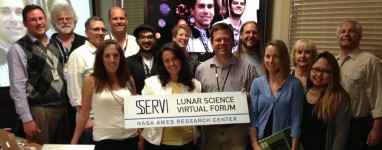
The SSERVI crew posing after a well run #LSF13
The SSERVI crew posing after a well-run virtual forum.
This being an all-virtual forum there were naturally some challenges and issues. Overall, the folks at SSERVI (I believe most of them were at AMES) did a really great job with most of the technical issues while the problems seemed to stem from participants who failed to pay attention to instructions. The agenda includes links to the entire archived conference, which can play back in real-time including all the chat features and user blunders. It's kind of cool actually. Definitely one of the advantages to an all virtual conference is that things like a complete archive of all the session is readily attained. Indeed, you can even check me out in the Lightning Talks here. :)

One can easily garner the gist of current research and focus by looking over the agenda titles with lunar geology dominating most of the sessions (naturally), although there was a fair sprinkling of volatiles, exospheres, human exploration, heliophysics and other misc. items scattered throughout. The individual speakers ranged from extremely fascinating to hard-to-understand-for-various-reasons to dry-n-pedantic and the variation was largely independent of the subject matter.

The basic format was to have one or two general speakers do an introduction of sorts to the subject matter for the day. These were largely interesting and well done, giving brief overviews of the relevant issues and subject matter. For instance, the second day opened up with some quick introductions to geology and volatiles as they are present on the moon. Dana Hurley, of the John Hopkins Applied Physics Lab, began with an insight about how when she started in the field 15 years ago the questions would have been about whether or not water existed on the Moon, a question we now have thoroughly answered. The questions now, she asks, are: 1) What are the present day abundances of volatiles and 2) what is the actual composition of these volatiles? You can see her concise overview talk here but it seemed to reflect the general consensus that we have learned a whole lot recently and are about to learn a whole lot more.

Throughout the forum (I keep wanting to say conference) there was a lot of talk about LADEE, which is natural as it is about to launch (window opens Sept. 6 - see launch details) and will give a lot of science to most of the people attending the forum. It's interesting to see all the different components with LADEE and I can't seem to shake the feeling that everyone is trying to simultaneously pat each other on the back as well as up-sale the LADEE mission in an effort to convince people it is worthwhile. Actually, this is more the feeling I get out of everything that comes from NASA these days, which makes sense as they face large budget cuts and a public that is skeptical of spending money on things they don't understand. Including the need for lunar forums.

On a personal end, and as mentioned, I did participate in the Lightning Talks, with Krystal giving a good overview of the hard work she has been doing that I have been helping volunteer with. I also gave a quick summary of some of my plans to create an easy to use data acquisition black-box kind of thing for the lunar impact monitoring (details later). Overall, it was nice to get the (brief) exposure and a good chance to tout both PISCES and UH-Hilo.

SSERVI's concluding note highlights a few areas of interest, including the awards ceremonies, and links to the relevant areas. Below are a few talks that I thought were cool, in no particular order:

Wednesday, May 1, 2013

Dr. Buzz Aldrin and the Aldrin Cycler

I attended a Space Studies seminar yesterday up on campus in which they were watching a private video of a speech given by Dr. Buzz Aldrin to a group of PISCES members and supporters during the annual PISCES conference. This last year featured Dr. Aldrin speaking at the Waikoloa resort about a number of ideas, but mostly focused on the ideas of a united space policy, across all sectors and countries, as well as a tour and discussion of the Aldrin Cycler, again with some political asides on the part of Buzz being Buzz.

Artist depiction of an Aldrin Cycler. via
Throughout the video Buzz seemed lively and excited, often pausing to collect his thoughts and really appear to be speaking with genuine interest about the subject. He remarked early on about how he was without a teleprompter and took this opportunity to make his first jab at the President. Most of his remarks were off the cuff and of good-natured humor but he clearly has some gripes with the administration, past and present, and the lack of continued interest in the space program in general and things like the Apollo Missions in particular.

The talk was split into two main areas, the first in which Dr. Aldrin spoke in general terms about his ideas for space exploration going forward. As he stated, the idea is to "explore commercially developed and permanently settled space" He started right out by citing three core ideas of any space policy going forward: 1) strong leadership, 2) a sustainable path, and  3) long-term ambitions. Interestingly enough, I thought Dr. Aldrin's discussion about strong leadership and a united space policy, while all around interesting and full of nothing that be considered negative, still seemed to be confused, almost pandering to both sides about what a space program should look like going forward. And what are those two sides Buzz is pandering to? On the one hand, he repeatedly used words like "united," "collaboration," "coming together," and "cooperation" while speaking of public, private, international, and, frankly, all sectors and peoples that will be interested in space in the coming century. And everything he calls for is sound and logical, as it is important that we have united in policy and ideas going forward.

Yet, on the other hand, most of his speech was essentially about how the USA can maintain "leadership" in the coming years, and about how we don't want to send astronauts to the Moon, "only to find the Chinese already there." Overall, his general idea was that while other countries are focused on returning humans to the lunar surface, we need to start concentrating on how to get to Mars, thus staying one step ahead of the competition, as it were. Interestingly, Buzz, having had his chance to leap about the lunar surface, does not advocate directly sending humans to Mars although that is definitely part of his long-term plan and a critical feature of the Aldrin Cycler. But, "if we're not sending people [to a planetary surface]  than how can we be leaders? We do it by knowing more than anybody else."

Here Buzz seemed to be spot on in his assessment, namely that we are going to fail, we are going to make mistakes, but we just need to start trying. We (here implying the USA) need to maintain our leadership with this ability to try and fail, while all the while learning.

The first half of the talk was filled with these kind of  practical orations. "Today, collaboration [international, public, government, state, private, etc.] is an essential element for our success." We must, "[take] into account all the other countries space policy objectives." "I'm going to talk to you about a unified space exploration."

PISCES was also given its requisite amount of fan-fare: "As the space faring community comes together to embark...PISCES will lead in a unique and critical role in this vital new enterprise in space." "Begin with PISCES and extend to cislunar space and beyond." "But even more important, PISCES is to lead the construction of the lunar base."  And so on.

The second half of the talk Buzz focused on the Aldrin, or Mars Cycler, and practical attempts and methods to actually start getting to Mars. Dr. Buzz Aldrin actually has his PhD in Orbital Mechanics, so it's not just some guy who has walked on the Moon speaking here, he does actually know what he is talking about. Again, the central theme here seemed to be that we just need to start doing it and stop being afraid. There was a fair amount of modestly technical information about the Cycler, which refers both to the synodic period as well as the actual spacecraft Buzz envisions. [Details can be found on  Buzz's site.]

There was actually a lot more to the talk and I have a good page of pithy quotes given by Buzz. All in
all, it was actually a very interesting talk and always good to see an 80-year-old Buzz Aldrin still just as excited about humans getting into space.

A few items to share:

  • On unity: Buzz wants to create a United Strategic and Space Enterprise foundation to foster this internal and global unity. That's right, it does have the name USS Enterprise, and this is, obviously, on purpose.
  • On outreach and the public: "We really need to get philosophers, [and] people that are historians, to really think and look at what the earth is capable of doing. It is capable of taking humans beings and putting them on another surface in our solar system."
  • On our legacy: "Thousands of years from now we will look back on the leader that committed a group of people to [reach the surface of Mars]."
  • And, "That's why they're going to be the pilgrims."

Thursday, April 18, 2013

Business Breakfast with PISCES

The Pacific International Space Center for Exploration Systems
is an international research and education center dedicated to
sustaining life on the moon and beyond. Recent agreements
have added new breath to the organization, fostering business
developments in Hawaii.
This morning I had the chance to attend a breakfast conversation organized by Hui Ka Ua with a special talk given by Rob Kelso, the new Executive Director of PISCES. Since I have been doing some work this semester with the LADEE project under the auspices of PISCES, this was a great opportunity to see what some of the future plans and developments are with PISCES, especially with regard to the Big Island. Indeed, since this was partly a talk organized by a business organization, much of the information that Kelso conveyed was focused on the local business developments that will arise as the result of the PISCES work now being done. Highlighting all of this was a press release from PISCES that was handed out before-hand which talks about the six new Memoranda of Understandings (MOUs) that have been signed with various governments and organizations throughout the world that will funnel jobs and technology back to Hawaii. Rob Kelso, from the press release:
Many of the initiatives involve robotics, construction material research, renewable energy and telecommunications. The benefit will not only be technologies for use on planetary surfaces, but also innovative technologies that can have immediate application for the Hawaii economy and the general well-being of the State.
The MOUs span a variety of technologies but all gravitate around the blossoming aerospace industry on Hawaii, including 3D printing technologies and other advanced fabrication techniques. Kelso didn't address any of these directly but spoke more in general terms about how Hawaii is very well situated for future international developments, pinpointing the centrality in the Pacific, the unique environmental conditions on Big Island (a lot of time spent here), the fact that there are two international airports, two deep-sea ports, and a variety of power generation mechanisms (think geothermal).

Interestingly, Kelso mentioned plans for such things as an aerospace technology park on Big Island, a multitude of conferences and educational drives, and all around exhibited a lot of energy about the project. Opening his talk, Kelso also mentioned how he was learning the etymologies of 'Haole' and 'Aloha' and talked about how he wanted to arrive (as a foreigner to the state) but wanted to be welcomed into the island and to really have PISCES be an organization that works with the peoples and future of Hawaii, rather than one that merely utilizes the resources. Very apt as an opening, as it is precisely a new and fresh breath that PISCES has been given ("the first MOU's [sic] in five years for PISCES") with his arrival. As someone who is trying to be involved with PISCES long-term, it is personally exciting to see some progress and change being made and it was great to be able to attend this morning session. Mahalo to Hui Ka Ua and PISCES for organizing the event.